MATHHX B
\(\newcommand{\footnotename}{footnote}\)
\(\def \LWRfootnote {1}\)
\(\newcommand {\footnote }[2][\LWRfootnote ]{{}^{\mathrm {#1}}}\)
\(\newcommand {\footnotemark }[1][\LWRfootnote ]{{}^{\mathrm {#1}}}\)
\(\let \LWRorighspace \hspace \)
\(\renewcommand {\hspace }{\ifstar \LWRorighspace \LWRorighspace }\)
\(\newcommand {\TextOrMath }[2]{#2}\)
\(\newcommand {\mathnormal }[1]{{#1}}\)
\(\newcommand \ensuremath [1]{#1}\)
\(\newcommand {\LWRframebox }[2][]{\fbox {#2}} \newcommand {\framebox }[1][]{\LWRframebox } \)
\(\newcommand {\setlength }[2]{}\)
\(\newcommand {\addtolength }[2]{}\)
\(\newcommand {\setcounter }[2]{}\)
\(\newcommand {\addtocounter }[2]{}\)
\(\newcommand {\arabic }[1]{}\)
\(\newcommand {\number }[1]{}\)
\(\newcommand {\noalign }[1]{\text {#1}\notag \\}\)
\(\newcommand {\cline }[1]{}\)
\(\newcommand {\directlua }[1]{\text {(directlua)}}\)
\(\newcommand {\luatexdirectlua }[1]{\text {(directlua)}}\)
\(\newcommand {\protect }{}\)
\(\def \LWRabsorbnumber #1 {}\)
\(\def \LWRabsorbquotenumber "#1 {}\)
\(\newcommand {\LWRabsorboption }[1][]{}\)
\(\newcommand {\LWRabsorbtwooptions }[1][]{\LWRabsorboption }\)
\(\def \mathchar {\ifnextchar "\LWRabsorbquotenumber \LWRabsorbnumber }\)
\(\def \mathcode #1={\mathchar }\)
\(\let \delcode \mathcode \)
\(\let \delimiter \mathchar \)
\(\def \oe {\unicode {x0153}}\)
\(\def \OE {\unicode {x0152}}\)
\(\def \ae {\unicode {x00E6}}\)
\(\def \AE {\unicode {x00C6}}\)
\(\def \aa {\unicode {x00E5}}\)
\(\def \AA {\unicode {x00C5}}\)
\(\def \o {\unicode {x00F8}}\)
\(\def \O {\unicode {x00D8}}\)
\(\def \l {\unicode {x0142}}\)
\(\def \L {\unicode {x0141}}\)
\(\def \ss {\unicode {x00DF}}\)
\(\def \SS {\unicode {x1E9E}}\)
\(\def \dag {\unicode {x2020}}\)
\(\def \ddag {\unicode {x2021}}\)
\(\def \P {\unicode {x00B6}}\)
\(\def \copyright {\unicode {x00A9}}\)
\(\def \pounds {\unicode {x00A3}}\)
\(\let \LWRref \ref \)
\(\renewcommand {\ref }{\ifstar \LWRref \LWRref }\)
\( \newcommand {\multicolumn }[3]{#3}\)
\(\require {textcomp}\)
\(\require {colortbl}\)
\(\let \LWRorigcolumncolor \columncolor \)
\(\renewcommand {\columncolor }[2][named]{\LWRorigcolumncolor [#1]{#2}\LWRabsorbtwooptions }\)
\(\let \LWRorigrowcolor \rowcolor \)
\(\renewcommand {\rowcolor }[2][named]{\LWRorigrowcolor [#1]{#2}\LWRabsorbtwooptions }\)
\(\let \LWRorigcellcolor \cellcolor \)
\(\renewcommand {\cellcolor }[2][named]{\LWRorigcellcolor [#1]{#2}\LWRabsorbtwooptions }\)
\(\newcommand {\tothe }[1]{^{#1}}\)
\(\newcommand {\raiseto }[2]{{#2}^{#1}}\)
\(\newcommand {\LWRsiunitxEND }{}\)
\(\def \LWRsiunitxang #1;#2;#3;#4\LWRsiunitxEND {\ifblank {#1}{}{\num {#1}\degree }\ifblank {#2}{}{\num {#2}^{\unicode {x2032}}}\ifblank {#3}{}{\num {#3}^{\unicode {x2033}}}}\)
\(\newcommand {\ang }[2][]{\LWRsiunitxang #2;;;\LWRsiunitxEND }\)
\(\def \LWRsiunitxdistribunit {}\)
\(\newcommand {\LWRsiunitxENDTWO }{}\)
\(\def \LWRsiunitxprintdecimalsubtwo #1,#2,#3\LWRsiunitxENDTWO {\ifblank {#1}{0}{\mathrm {#1}}\ifblank {#2}{}{{\LWRsiunitxdecimal }\mathrm {#2}}}\)
\(\def \LWRsiunitxprintdecimalsub #1.#2.#3\LWRsiunitxEND {\LWRsiunitxprintdecimalsubtwo #1,,\LWRsiunitxENDTWO \ifblank {#2}{}{{\LWRsiunitxdecimal }\LWRsiunitxprintdecimalsubtwo
#2,,\LWRsiunitxENDTWO }}\)
\(\newcommand {\LWRsiunitxprintdecimal }[1]{\LWRsiunitxprintdecimalsub #1...\LWRsiunitxEND }\)
\(\def \LWRsiunitxnumplus #1+#2+#3\LWRsiunitxEND {\ifblank {#2}{\LWRsiunitxprintdecimal {#1}}{\ifblank {#1}{\LWRsiunitxprintdecimal {#2}}{\LWRsiunitxprintdecimal {#1}\unicode
{x02B}\LWRsiunitxprintdecimal {#2}}}\LWRsiunitxdistribunit }\)
\(\def \LWRsiunitxnumminus #1-#2-#3\LWRsiunitxEND {\ifblank {#2}{\LWRsiunitxnumplus #1+++\LWRsiunitxEND }{\ifblank {#1}{}{\LWRsiunitxprintdecimal {#1}}\unicode {x02212}\LWRsiunitxprintdecimal
{#2}\LWRsiunitxdistribunit }}\)
\(\def \LWRsiunitxnumpmmacro #1\pm #2\pm #3\LWRsiunitxEND {\ifblank {#2}{\LWRsiunitxnumminus #1---\LWRsiunitxEND }{\LWRsiunitxprintdecimal {#1}\unicode {x0B1}\LWRsiunitxprintdecimal
{#2}\LWRsiunitxdistribunit }}\)
\(\def \LWRsiunitxnumpm #1+-#2+-#3\LWRsiunitxEND {\ifblank {#2}{\LWRsiunitxnumpmmacro #1\pm \pm \pm \LWRsiunitxEND }{\LWRsiunitxprintdecimal {#1}\unicode {x0B1}\LWRsiunitxprintdecimal
{#2}\LWRsiunitxdistribunit }}\)
\(\newcommand {\LWRsiunitxnumscientific }[2]{\ifblank {#1}{}{\ifstrequal {#1}{-}{-}{\LWRsiunitxprintdecimal {#1}\times }}10^{\LWRsiunitxprintdecimal {#2}}\LWRsiunitxdistribunit }\)
\(\def \LWRsiunitxnumD #1D#2D#3\LWRsiunitxEND {\ifblank {#2}{\LWRsiunitxnumpm #1+-+-\LWRsiunitxEND }{\mathrm {\LWRsiunitxnumscientific {#1}{#2}}}}\)
\(\def \LWRsiunitxnumd #1d#2d#3\LWRsiunitxEND {\ifblank {#2}{\LWRsiunitxnumD #1DDD\LWRsiunitxEND }{\mathrm {\LWRsiunitxnumscientific {#1}{#2}}}}\)
\(\def \LWRsiunitxnumE #1E#2E#3\LWRsiunitxEND {\ifblank {#2}{\LWRsiunitxnumd #1ddd\LWRsiunitxEND }{\mathrm {\LWRsiunitxnumscientific {#1}{#2}}}}\)
\(\def \LWRsiunitxnume #1e#2e#3\LWRsiunitxEND {\ifblank {#2}{\LWRsiunitxnumE #1EEE\LWRsiunitxEND }{\mathrm {\LWRsiunitxnumscientific {#1}{#2}}}}\)
\(\def \LWRsiunitxnumx #1x#2x#3x#4\LWRsiunitxEND {\ifblank {#2}{\LWRsiunitxnume #1eee\LWRsiunitxEND }{\ifblank {#3}{\LWRsiunitxnume #1eee\LWRsiunitxEND \times \LWRsiunitxnume
#2eee\LWRsiunitxEND }{\LWRsiunitxnume #1eee\LWRsiunitxEND \times \LWRsiunitxnume #2eee\LWRsiunitxEND \times \LWRsiunitxnume #3eee\LWRsiunitxEND }}}\)
\(\newcommand {\num }[2][]{\LWRsiunitxnumx #2xxxxx\LWRsiunitxEND }\)
\(\newcommand {\si }[2][]{\mathrm {\gsubstitute {#2}{~}{\,}}}\)
\(\def \LWRsiunitxSIopt #1[#2]#3{\def \LWRsiunitxdistribunit {\,\si {#3}}{#2}\num {#1}\def \LWRsiunitxdistribunit {}}\)
\(\newcommand {\LWRsiunitxSI }[2]{\def \LWRsiunitxdistribunit {\,\si {#2}}\num {#1}\def \LWRsiunitxdistribunit {}}\)
\(\newcommand {\SI }[2][]{\ifnextchar [{\LWRsiunitxSIopt {#2}}{\LWRsiunitxSI {#2}}}\)
\(\newcommand {\numlist }[2][]{\text {#2}}\)
\(\newcommand {\numrange }[3][]{\num {#2}\ \LWRsiunitxrangephrase \ \num {#3}}\)
\(\newcommand {\SIlist }[3][]{\text {#2}\,\si {#3}}\)
\(\newcommand {\SIrange }[4][]{\num {#2}\,#4\ \LWRsiunitxrangephrase \ \num {#3}\,#4}\)
\(\newcommand {\tablenum }[2][]{\mathrm {#2}}\)
\(\newcommand {\ampere }{\mathrm {A}}\)
\(\newcommand {\candela }{\mathrm {cd}}\)
\(\newcommand {\kelvin }{\mathrm {K}}\)
\(\newcommand {\kilogram }{\mathrm {kg}}\)
\(\newcommand {\metre }{\mathrm {m}}\)
\(\newcommand {\mole }{\mathrm {mol}}\)
\(\newcommand {\second }{\mathrm {s}}\)
\(\newcommand {\becquerel }{\mathrm {Bq}}\)
\(\newcommand {\degreeCelsius }{\unicode {x2103}}\)
\(\newcommand {\coulomb }{\mathrm {C}}\)
\(\newcommand {\farad }{\mathrm {F}}\)
\(\newcommand {\gray }{\mathrm {Gy}}\)
\(\newcommand {\hertz }{\mathrm {Hz}}\)
\(\newcommand {\henry }{\mathrm {H}}\)
\(\newcommand {\joule }{\mathrm {J}}\)
\(\newcommand {\katal }{\mathrm {kat}}\)
\(\newcommand {\lumen }{\mathrm {lm}}\)
\(\newcommand {\lux }{\mathrm {lx}}\)
\(\newcommand {\newton }{\mathrm {N}}\)
\(\newcommand {\ohm }{\mathrm {\Omega }}\)
\(\newcommand {\pascal }{\mathrm {Pa}}\)
\(\newcommand {\radian }{\mathrm {rad}}\)
\(\newcommand {\siemens }{\mathrm {S}}\)
\(\newcommand {\sievert }{\mathrm {Sv}}\)
\(\newcommand {\steradian }{\mathrm {sr}}\)
\(\newcommand {\tesla }{\mathrm {T}}\)
\(\newcommand {\volt }{\mathrm {V}}\)
\(\newcommand {\watt }{\mathrm {W}}\)
\(\newcommand {\weber }{\mathrm {Wb}}\)
\(\newcommand {\day }{\mathrm {d}}\)
\(\newcommand {\degree }{\mathrm {^\circ }}\)
\(\newcommand {\hectare }{\mathrm {ha}}\)
\(\newcommand {\hour }{\mathrm {h}}\)
\(\newcommand {\litre }{\mathrm {l}}\)
\(\newcommand {\liter }{\mathrm {L}}\)
\(\newcommand {\arcminute }{^\prime }\)
\(\newcommand {\minute }{\mathrm {min}}\)
\(\newcommand {\arcsecond }{^{\prime \prime }}\)
\(\newcommand {\tonne }{\mathrm {t}}\)
\(\newcommand {\astronomicalunit }{au}\)
\(\newcommand {\atomicmassunit }{u}\)
\(\newcommand {\bohr }{\mathit {a}_0}\)
\(\newcommand {\clight }{\mathit {c}_0}\)
\(\newcommand {\dalton }{\mathrm {D}_\mathrm {a}}\)
\(\newcommand {\electronmass }{\mathit {m}_{\mathrm {e}}}\)
\(\newcommand {\electronvolt }{\mathrm {eV}}\)
\(\newcommand {\elementarycharge }{\mathit {e}}\)
\(\newcommand {\hartree }{\mathit {E}_{\mathrm {h}}}\)
\(\newcommand {\planckbar }{\mathit {\unicode {x210F}}}\)
\(\newcommand {\angstrom }{\mathrm {\unicode {x212B}}}\)
\(\let \LWRorigbar \bar \)
\(\newcommand {\barn }{\mathrm {b}}\)
\(\newcommand {\bel }{\mathrm {B}}\)
\(\newcommand {\decibel }{\mathrm {dB}}\)
\(\newcommand {\knot }{\mathrm {kn}}\)
\(\newcommand {\mmHg }{\mathrm {mmHg}}\)
\(\newcommand {\nauticalmile }{\mathrm {M}}\)
\(\newcommand {\neper }{\mathrm {Np}}\)
\(\newcommand {\yocto }{\mathrm {y}}\)
\(\newcommand {\zepto }{\mathrm {z}}\)
\(\newcommand {\atto }{\mathrm {a}}\)
\(\newcommand {\femto }{\mathrm {f}}\)
\(\newcommand {\pico }{\mathrm {p}}\)
\(\newcommand {\nano }{\mathrm {n}}\)
\(\newcommand {\micro }{\mathrm {\unicode {x00B5}}}\)
\(\newcommand {\milli }{\mathrm {m}}\)
\(\newcommand {\centi }{\mathrm {c}}\)
\(\newcommand {\deci }{\mathrm {d}}\)
\(\newcommand {\deca }{\mathrm {da}}\)
\(\newcommand {\hecto }{\mathrm {h}}\)
\(\newcommand {\kilo }{\mathrm {k}}\)
\(\newcommand {\mega }{\mathrm {M}}\)
\(\newcommand {\giga }{\mathrm {G}}\)
\(\newcommand {\tera }{\mathrm {T}}\)
\(\newcommand {\peta }{\mathrm {P}}\)
\(\newcommand {\exa }{\mathrm {E}}\)
\(\newcommand {\zetta }{\mathrm {Z}}\)
\(\newcommand {\yotta }{\mathrm {Y}}\)
\(\newcommand {\percent }{\mathrm {\%}}\)
\(\newcommand {\meter }{\mathrm {m}}\)
\(\newcommand {\metre }{\mathrm {m}}\)
\(\newcommand {\gram }{\mathrm {g}}\)
\(\newcommand {\kg }{\kilo \gram }\)
\(\newcommand {\of }[1]{_{\mathrm {#1}}}\)
\(\newcommand {\squared }{^2}\)
\(\newcommand {\square }[1]{\mathrm {#1}^2}\)
\(\newcommand {\cubed }{^3}\)
\(\newcommand {\cubic }[1]{\mathrm {#1}^3}\)
\(\newcommand {\per }{\,\mathrm {/}}\)
\(\newcommand {\celsius }{\unicode {x2103}}\)
\(\newcommand {\fg }{\femto \gram }\)
\(\newcommand {\pg }{\pico \gram }\)
\(\newcommand {\ng }{\nano \gram }\)
\(\newcommand {\ug }{\micro \gram }\)
\(\newcommand {\mg }{\milli \gram }\)
\(\newcommand {\g }{\gram }\)
\(\newcommand {\kg }{\kilo \gram }\)
\(\newcommand {\amu }{\mathrm {u}}\)
\(\newcommand {\nm }{\nano \metre }\)
\(\newcommand {\um }{\micro \metre }\)
\(\newcommand {\mm }{\milli \metre }\)
\(\newcommand {\cm }{\centi \metre }\)
\(\newcommand {\dm }{\deci \metre }\)
\(\newcommand {\m }{\metre }\)
\(\newcommand {\km }{\kilo \metre }\)
\(\newcommand {\as }{\atto \second }\)
\(\newcommand {\fs }{\femto \second }\)
\(\newcommand {\ps }{\pico \second }\)
\(\newcommand {\ns }{\nano \second }\)
\(\newcommand {\us }{\micro \second }\)
\(\newcommand {\ms }{\milli \second }\)
\(\newcommand {\s }{\second }\)
\(\newcommand {\fmol }{\femto \mol }\)
\(\newcommand {\pmol }{\pico \mol }\)
\(\newcommand {\nmol }{\nano \mol }\)
\(\newcommand {\umol }{\micro \mol }\)
\(\newcommand {\mmol }{\milli \mol }\)
\(\newcommand {\mol }{\mol }\)
\(\newcommand {\kmol }{\kilo \mol }\)
\(\newcommand {\pA }{\pico \ampere }\)
\(\newcommand {\nA }{\nano \ampere }\)
\(\newcommand {\uA }{\micro \ampere }\)
\(\newcommand {\mA }{\milli \ampere }\)
\(\newcommand {\A }{\ampere }\)
\(\newcommand {\kA }{\kilo \ampere }\)
\(\newcommand {\ul }{\micro \litre }\)
\(\newcommand {\ml }{\milli \litre }\)
\(\newcommand {\l }{\litre }\)
\(\newcommand {\hl }{\hecto \litre }\)
\(\newcommand {\uL }{\micro \liter }\)
\(\newcommand {\mL }{\milli \liter }\)
\(\newcommand {\L }{\liter }\)
\(\newcommand {\hL }{\hecto \liter }\)
\(\newcommand {\mHz }{\milli \hertz }\)
\(\newcommand {\Hz }{\hertz }\)
\(\newcommand {\kHz }{\kilo \hertz }\)
\(\newcommand {\MHz }{\mega \hertz }\)
\(\newcommand {\GHz }{\giga \hertz }\)
\(\newcommand {\THz }{\tera \hertz }\)
\(\newcommand {\mN }{\milli \newton }\)
\(\newcommand {\N }{\newton }\)
\(\newcommand {\kN }{\kilo \newton }\)
\(\newcommand {\MN }{\mega \newton }\)
\(\newcommand {\Pa }{\pascal }\)
\(\newcommand {\kPa }{\kilo \pascal }\)
\(\newcommand {\MPa }{\mega \pascal }\)
\(\newcommand {\GPa }{\giga \pascal }\)
\(\newcommand {\mohm }{\milli \ohm }\)
\(\newcommand {\kohm }{\kilo \ohm }\)
\(\newcommand {\Mohm }{\mega \ohm }\)
\(\newcommand {\pV }{\pico \volt }\)
\(\newcommand {\nV }{\nano \volt }\)
\(\newcommand {\uV }{\micro \volt }\)
\(\newcommand {\mV }{\milli \volt }\)
\(\newcommand {\V }{\volt }\)
\(\newcommand {\kV }{\kilo \volt }\)
\(\newcommand {\W }{\watt }\)
\(\newcommand {\uW }{\micro \watt }\)
\(\newcommand {\mW }{\milli \watt }\)
\(\newcommand {\kW }{\kilo \watt }\)
\(\newcommand {\MW }{\mega \watt }\)
\(\newcommand {\GW }{\giga \watt }\)
\(\newcommand {\J }{\joule }\)
\(\newcommand {\uJ }{\micro \joule }\)
\(\newcommand {\mJ }{\milli \joule }\)
\(\newcommand {\kJ }{\kilo \joule }\)
\(\newcommand {\eV }{\electronvolt }\)
\(\newcommand {\meV }{\milli \electronvolt }\)
\(\newcommand {\keV }{\kilo \electronvolt }\)
\(\newcommand {\MeV }{\mega \electronvolt }\)
\(\newcommand {\GeV }{\giga \electronvolt }\)
\(\newcommand {\TeV }{\tera \electronvolt }\)
\(\newcommand {\kWh }{\kilo \watt \hour }\)
\(\newcommand {\F }{\farad }\)
\(\newcommand {\fF }{\femto \farad }\)
\(\newcommand {\pF }{\pico \farad }\)
\(\newcommand {\K }{\mathrm {K}}\)
\(\newcommand {\dB }{\mathrm {dB}}\)
\(\newcommand {\kibi }{\mathrm {Ki}}\)
\(\newcommand {\mebi }{\mathrm {Mi}}\)
\(\newcommand {\gibi }{\mathrm {Gi}}\)
\(\newcommand {\tebi }{\mathrm {Ti}}\)
\(\newcommand {\pebi }{\mathrm {Pi}}\)
\(\newcommand {\exbi }{\mathrm {Ei}}\)
\(\newcommand {\zebi }{\mathrm {Zi}}\)
\(\newcommand {\yobi }{\mathrm {Yi}}\)
\(\let \unit \si \)
\(\let \qty \SI \)
\(\let \qtylist \SIlist \)
\(\let \qtyrange \SIrange \)
\(\let \numproduct \num \)
\(\let \qtyproduct \SI \)
\(\let \complexnum \num \)
\(\newcommand {\complexqty }[3][]{(\complexnum {#2})\si {#3}}\)
\(\newcommand {\mleft }{\left }\)
\(\newcommand {\mright }{\right }\)
\(\newcommand {\mleftright }{}\)
\(\newcommand {\mleftrightrestore }{}\)
\(\require {gensymb}\)
\(\newcommand {\intertext }[1]{\text {#1}\notag \\}\)
\(\let \Hat \hat \)
\(\let \Check \check \)
\(\let \Tilde \tilde \)
\(\let \Acute \acute \)
\(\let \Grave \grave \)
\(\let \Dot \dot \)
\(\let \Ddot \ddot \)
\(\let \Breve \breve \)
\(\let \Bar \bar \)
\(\let \Vec \vec \)
\(\require {cancel}\)
\(\newcommand {\mathred }[1]{\textcolor [rgb]{1, 0, 0}{#1}}\)
\(\newcommand {\mathgreen }[1]{\textcolor [rgb]{0,0.5,0}{#1}}\)
\(\newcommand {\mathblue }[1]{\textcolor [rgb]{0,0,1}{#1}}\)
\(\newcommand {\mathorange }[1]{\textcolor [rgb]{1,0.5,0}{#1}}\)
\(\newcommand {\mathmagenta }[1]{\textcolor [cmyk]{0, 1, 1, 0.33}{#1}}\)
\( \newcommand \ccancel [2][red]{\renewcommand \CancelColor {\color {#1}}\cancel {#2}} \)
\(\newcommand {\Dom }{\operatorname {Dom}}\)
\(\newcommand {\Ran }{\operatorname {Ran}}\)
\(\newcommand {\Dm }{\operatorname {Dm}}\)
\(\newcommand {\Vm }{\operatorname {Vm}}\)
\(\newcommand {\Var }{\operatorname {Var}}\)
\(\newcommand {\SD }{\operatorname {SD}}\)
\(\newcommand {\ExV }{\operatorname {E}}\)
\(\newcommand {\opointtext }{\textcolor {blue}{\circ }}\)
\(\newcommand {\cpointtext }{\textcolor {blue}{\bullet }}\)
\(\newcommand {\vectwo }[2]{\begin {pmatrix} #1 \\ #2 \end {pmatrix}}\)
\(\newcommand {\tcbset }[1]{}\)
\(\newcommand {\tcbsetforeverylayer }[1]{}\)
\(\newcommand {\tcbox }[2][]{\boxed {\text {#2}}}\)
\(\newcommand {\tcboxfit }[2][]{\boxed {#2}}\)
\(\newcommand {\tcblower }{}\)
\(\newcommand {\tcbline }{}\)
\(\newcommand {\tcbtitle }{}\)
\(\newcommand {\tcbsubtitle [2][]{\mathrm {#2}}}\)
\(\newcommand {\tcboxmath }[2][]{\boxed {#2}}\)
\(\newcommand {\tcbhighmath }[2][]{\boxed {#2}}\)
\(\newcommand {\toprule }[1][]{\hline }\)
\(\let \midrule \toprule \)
\(\let \bottomrule \toprule \)
\(\def \LWRbooktabscmidruleparen (#1)#2{}\)
\(\newcommand {\LWRbooktabscmidrulenoparen }[1]{}\)
\(\newcommand {\cmidrule }[1][]{\ifnextchar (\LWRbooktabscmidruleparen \LWRbooktabscmidrulenoparen }\)
\(\newcommand {\morecmidrules }{}\)
\(\newcommand {\specialrule }[3]{\hline }\)
\(\newcommand {\addlinespace }[1][]{}\)
\(\def \LWRsiunitxrangephrase {\TextOrMath { }{\ }\protect \mbox {to (numerical range)}\TextOrMath { }{\ }}\)
\(\def \LWRsiunitxdecimal {.}\)
2.2 Grafer
En graf er en visuel fremstilling af en funktion i et koordinatsystem. I dette afsnit skal du tegne grafer med papir og blyant, så find noget ternet papir frem.
Koordinatsystemer og punkter
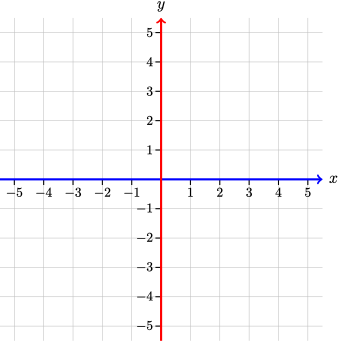
Et koordinatsystem ser således ud:
Den grønne linje kaldes \(x\)-aksen eller førsteaksen, og den røde kaldes \(y\)-aksen eller
andenaksen. Normalt farver man ikke akserne.
I koordinatsystemet kan man tegne punkter. Et punkt er et talpar som f.eks.
\[P(3,2)\]
Det første tal kaldes \(x\)-koordinaten eller førstekoordinaten, og det andet tal kaldes \(y\)-koordinaten eller
andenkoordinaten. Har man svært ved at huske, hvad der kommer først, kan man huske, at \(x\) kommer før \(y\) i alfabetet. Vi kan tegne punktet \(P\) ind i et koordinatsystem ud fra
\(3\) på \(x\)-aksen og \(2\) på \(y\)-aksen som vist her:
Øvelse 2.2.1
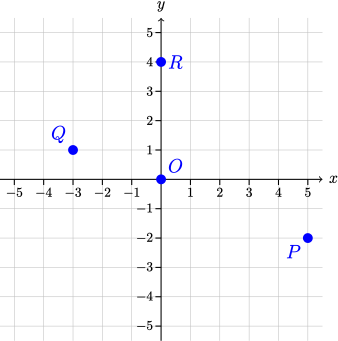
Betragt koordinatsystemet med punkterne \(O\), \(P\), \(Q\) og \(R\):
-
a) Opskriv punktet \(P\).
-
b) Opskriv punktet \(R\).
-
c) Hvad er \(y\)-koordinaten til \(Q\)?
-
d) Hvilke af punkterne ligger på \(x\)-aksen?
-
e) Hvilke af punkterne ligger på \(y\)-aksen?
2.2.1
-
a) \(P(5,-2)\)
-
b) \(R(0,4)\)
-
c) \(1\)
-
d) \(O\)
-
e) \(O\) og \(R\)
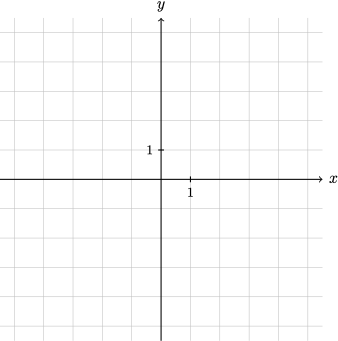
Om lidt skal du tegne koordinatsystemer. Da det tager ulidelig lang tid at skrive tallene på akserne, kan du nøjes med at skrive et enkelt tal på hver akse som vist her:
Øvelse 2.2.2
Tegn et koordinatsystem på et stykke ternet papir.
2.2.2
-
a) 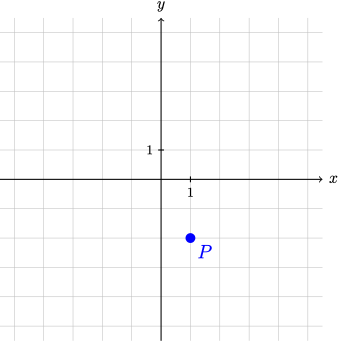
Når man angiver punkter, behøver man ikke at navngive dem med \(P\), \(Q\), osv. Det betyder, at man kan angive et punkt som \((3,2)\) i stedet for f.eks. \(P(3,2)\). Hvis ikke man har brug for at referere til punktet senere
hen, vil man typisk ikke give det et navn.
Forskrifter og grafer
En graf for en funktion \(f\) består af punkter \((x,y)\), hvor \(y=f(x)\), tegnet i et koordinatsystem. Man vælger selv \(x\)-værdierne, og så regner man \(y\)-værdierne ved at sætte
\(x\)-værdierne ind i funktionens forskrift. Det er nemmest at forstå igennem et eksempel.
-
Eksempel 2.2.1
Vi vil tegne grafen for funktionen \(f(x)=x+1\). Vi vælger \(x\)-værdierne til at gå fra \(-3\) til \(3\) og regner de tilhørende funktionsværdier ved at sætte ind i
forskriften. Den første funktionsværdi bliver:
\[ f(\mathgreen {-3})=-3+1=\mathred {-2} \]
Vi skriver de valgte \(x\)-værdier og den beregnede funktionsværdi ind i en tabel:
\(\begin {array} {| c | c | c | c | c | c | c | c | c | c |} \hline x & \mathgreen {-3} & -2 & -1 & 0 & 1 & 2 & 3 \\ \hline f(x) & \mathred {-2}& & &
& & & \\ \hline \end {array}\)
Vi regner nu resten af tabellen på samme måde:
\(\begin {array} {| c | c | c | c | c | c | c | c | c | c |} \hline x & \mathgreen {-3} & -2 & -1 & 0 & 1 & 2& 3 \\ \hline f(x) & \mathred {-2} & -1 & 0
& 1 & 2 & 3 & 4 \\ \hline \end {array}\)
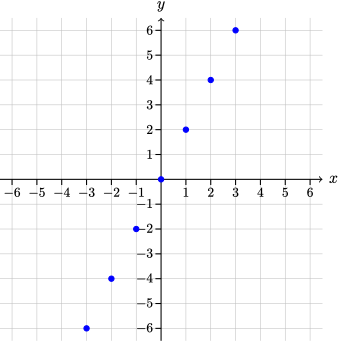
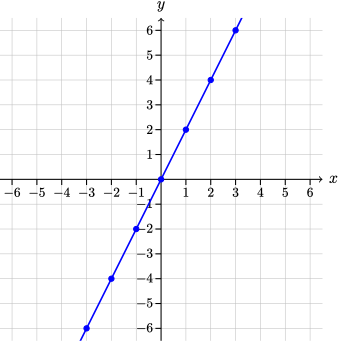
En sådan tabel kaldes også et sildeben. Vi tegner grafen for \(f\) ud fra sildebenet. Her bliver hver kolonne til et punkt i et koordinatsystem, så første punkt bliver altså \((\mathgreen
{-3},\mathred {-2})\). Tegner vi alle punkterne fra sildebenet, får vi:
Grafen for \(f\) tegnes ved at forbinde punkterne med en ”blød” kurve fra venstre mod højre.
Vi kan se, at grafen i eksemplet er en linje. Funktioner, hvis grafer er linjer, kaldes lineære funktioner, og i næste kapitel vil du lære en hurtigere metode til at tegne dem. Ud fra eksemplet er det måske ikke klart, hvad ”blød”
betyder, men det betyder, at grafen skal tegnes uden ”skarpe knæk”.
Øvelse 2.2.3
Nedenunder ses et sildeben for funktionen \(f(x)=x^2-5\).
\(\begin {array} {| c | c | c | c | c | c | c | c |} \hline x & -3 & -2 & -1 & 0 & 1 & 2& 3 \\ \hline f(x) & & -1 & & -5 & & -1 & 4 \\
\hline \end {array}\)
-
a) Regn de tomme felter i sildebenet.
-
b) Tegn grafen for \(f\). Husk, at grafen skal være blød (ikke spids).
2.2.3
-
a) \(\begin {array} {| c | c | c | c | c | c | c | c |} \hline x & -3 & -2 & -1 & 0 & 1 & 2& 3 \\
\hline f(x) & 4 & -1 & -4 & -5 & -4 & -1 & 4 \\ \hline \end {array}\)
-
b) 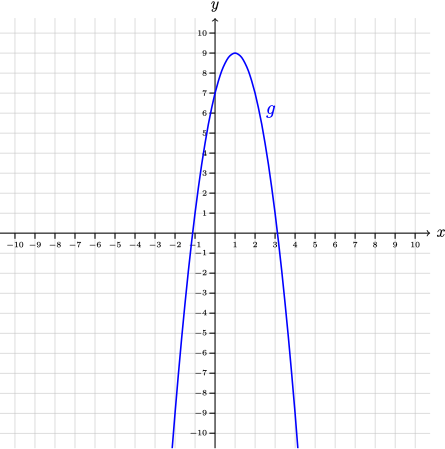 Fik du den rigtige runding i bunden?
Øvelse 2.2.4
Lad \(f(x)=x^3-3x\), og betragt det tilhørende sildeben:
\(\begin {array} {| c | c | c | c | c | c | c | c |} \hline x &-2{,}2 &-2 & -1 & 0 & 1 & 2 & 2{,}2 \\ \hline f(x) & -4 & & & & -2 & 2 &
4\\ \hline \end {array}\)
2.2.4
-
a) \(\begin {array} {| c | c | c | c | c | c | c| c |} \hline x &-2{,}2 &-2 & -1 & 0 & 1 & 2 & 2{,}2
\\ \hline f(x) & -4& -2 & 2 & 0 & -2 & 2 & 4\\ \hline \end {array}\)
-
b) 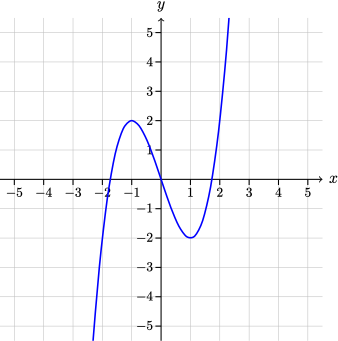 Ligner din graf? Måske er der liiige i underkanten med punkter i sildebenet til at kunne tegne grafen præcist.
Der er ingen faste regler for valg af \(x\)-værdier til sildebenet, men det gælder om at have nok punkter til, at man ikke er i tvivl om grafens forløb.
Øvelse 2.2.5
Lad \(f(x)=-0{,}5x-1\) og \(g(x)=-2\).
2.2.5
-
a) 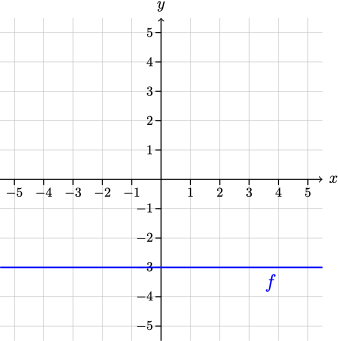
Øvelse 2.2.6
Lad \(f(x)=-x+4\).
Øvelse 2.2.7
Lad \(r(x)=\frac {1}{x}\).
2.2.7
-
a) 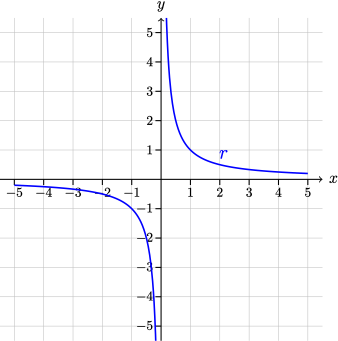
Der kan optræde begrænsninger på funktioner. Betragt funktionen:
\[f(x)=x+1 \quad , \quad -3\leq x < 2\]
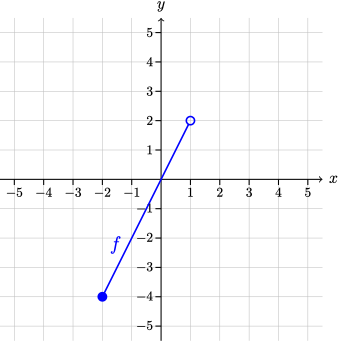
Denne funktion er magen til funktionen \(f(x)=x+1\), bortset fra at \(x\) skal begrænses til intervallet \([-3;2[\). Grafen ser således ud:
Her har vi begrænset grafen, så alle \(x\)-værdierne ligger i intervallet \([-3;2[\). Da \(x=-3\) ligger i \([-3;2[\) er punktet \((-3,-2)\) en del af grafen, hvilket vi markerer med \(\cpointtext \). Da \(x=2\) ikke ligger i
\([-3;2[\), ligger punktet \((2,3)\) ikke på grafen, hvilket vi markerer med \(\opointtext \).
Et punkt, markeret med \(\cpointtext \), kaldes et lukket endepunkt, mens et punkt, markeret med \(\opointtext \), kaldes
et åbent endepunkt.
Øvelse 2.2.8
Lad
\[ f(x)=\frac {8}{x} \quad , \quad 2 < x \leq 8 \]
og
\[ g(x)=3 \quad , \quad x>4 \]
2.2.8
-
a) 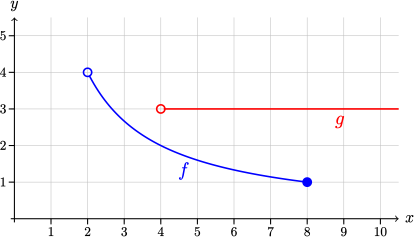
-
Eksempel 2.2.2
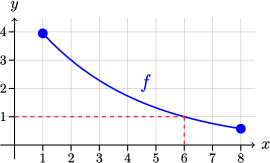
Betragt grafen for funktionen \(f\):
Ud fra grafen kan vi bestemme funktionsværdien \(f(2)\) ved at finde \(2\) på \(x\)-aksen, gå op til vi møder grafen, og så aflæse andenkoordinaten:
Vi ser, at \(f(2)=3\).
Vi vil nu bruge grafen til at løse ligningen \(f(x)=1\). Her finder vi \(1\) på \(y\)-aksen, går ud til vi rammer grafen, og aflæser den tilhørende \(x\)-værdi:
Altså er \(x=6\) løsning til ligningen \(f(x)=1\).
De punkter, hvor to grafer skærer hinanden, kaldes skæringspunkter.
Øvelse 2.2.9
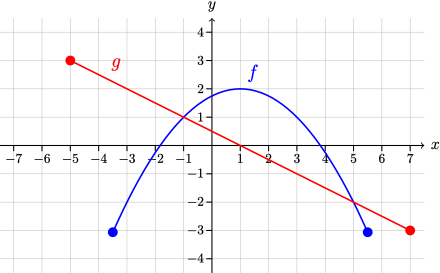
Betragt graferne for funktionerne \(f\) og \(g\):
-
a) Bestem \(f(3)\).
-
b) Bestem en løsning til \(g(x)=2\).
-
c) Bestem løsningerne til ligningen \(f(x)=-2\).
-
d) Bestem skæringspunkterne mellem graferne for \(f\) og \(g\).
Beregning af skæringspunkter mellem to grafer
Har man to funktioner, \(f\) og \(g\), kan man beregne grafernes skæringspunkter ved at sætte \(f(x)=g(x)\) og løse ligningen.
-
Eksempel 2.2.3
Vi vil beregne skæringspunktet mellem graferne for \(f(x)=-2x+2\) og \(g(x)=2x\). Vi sætter \(f(x)=g(x)\) og løser ligningen:
\(\seteqnumber{0}{2.}{0}\)
\begin{align*}
f(x) & =g(x)\\ -2x+2 &=2x && (\text {forskrifter indsat})\\ -4x & = -2\\[2pt] x &=\frac {-2}{-4}\\[2pt] x &= 0{,}5
\end{align*}
Så \(x\)-koordinaten til skæringspunktet er \(0{,}5\). Vi finder \(y\)-koordinaten ved at sætte \(x\)-værdien ind i forskriften for \(f\) eller \(g\). Vi vælger \(g\), da det er nemmest:
\[g(0{,}5)=2\cdot 0{,}5=1\]
Altså skærer \(f\) og \(g\) hinanden i punktet \((0{,}5;1)\).
Læg mærke til, at vi har brugt et semikolon til at adskille koordinaterne i punktet \((0{,}5;1)\). Det gør vi altid, når en af koordinaterne er et kommatal.
Øvelse 2.2.10
Bestem ved beregning eventuelle skæringspunkter mellem graferne for funktionerne:
-
a) \(f(x)=2x+1 \quad \textrm {og}\quad g(x)=-x+4\)
-
b) \(f(x)=2x \quad \textrm {og}\quad g(x)=2x+2\)
-
c) \(f(x)=\frac {1}{x} \quad \textrm {og}\quad g(x)=x\) ()
2.2.10
-
a) \((1,3)\)
-
b) Der er ingen skæringspunkter.
-
c) \((-1,-1)\) og \((1,1)\)
Øvelse 2.2.11 ()
Du skal nu tænke over den metode, du netop har benyttet.
Ikke alle kurver er grafer
Funktioner har kun én \(y\)-værdi til hver \(x\)-værdi, og dette begrænser, hvordan grafer kan se ud.
-
Eksempel 2.2.4
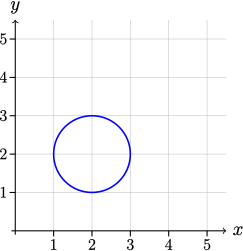
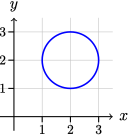
Betragt cirklen:
Vi ser, at cirklen går igennem både \((2,1)\) og \((2,3)\). Så hvis cirklen var graf for en funktion, skulle \(f(2)\) både være \(1\) og \(3\) på én gang. Måske kunne man aftale, at \(f(2)=1\) i hverdagen, og \(f(2)=3\) i
weekenden som et kompromis? Hahahah meget sjovt – nej, i matematik kan noget ikke have to forskellige værdier på én gang, så derfor kan cirklen ikke være graf for en funktion.
Øvelse 2.2.12
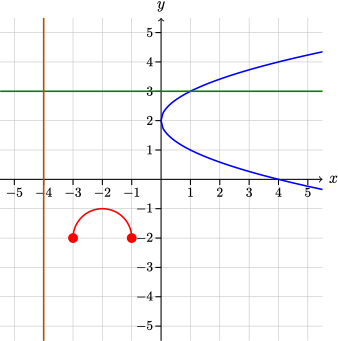
Betragt kurverne:
-
a) Kan den brune kurve være graf for en funktion?
-
b) Kan den grønne kurve være graf for en funktion?
-
c) Kan den røde kurve være graf for en funktion?
-
d) Kan den blå kurve være graf for en funktion?
2.2.12
-
a) nej
-
b) ja
-
c) ja
-
d) nej